
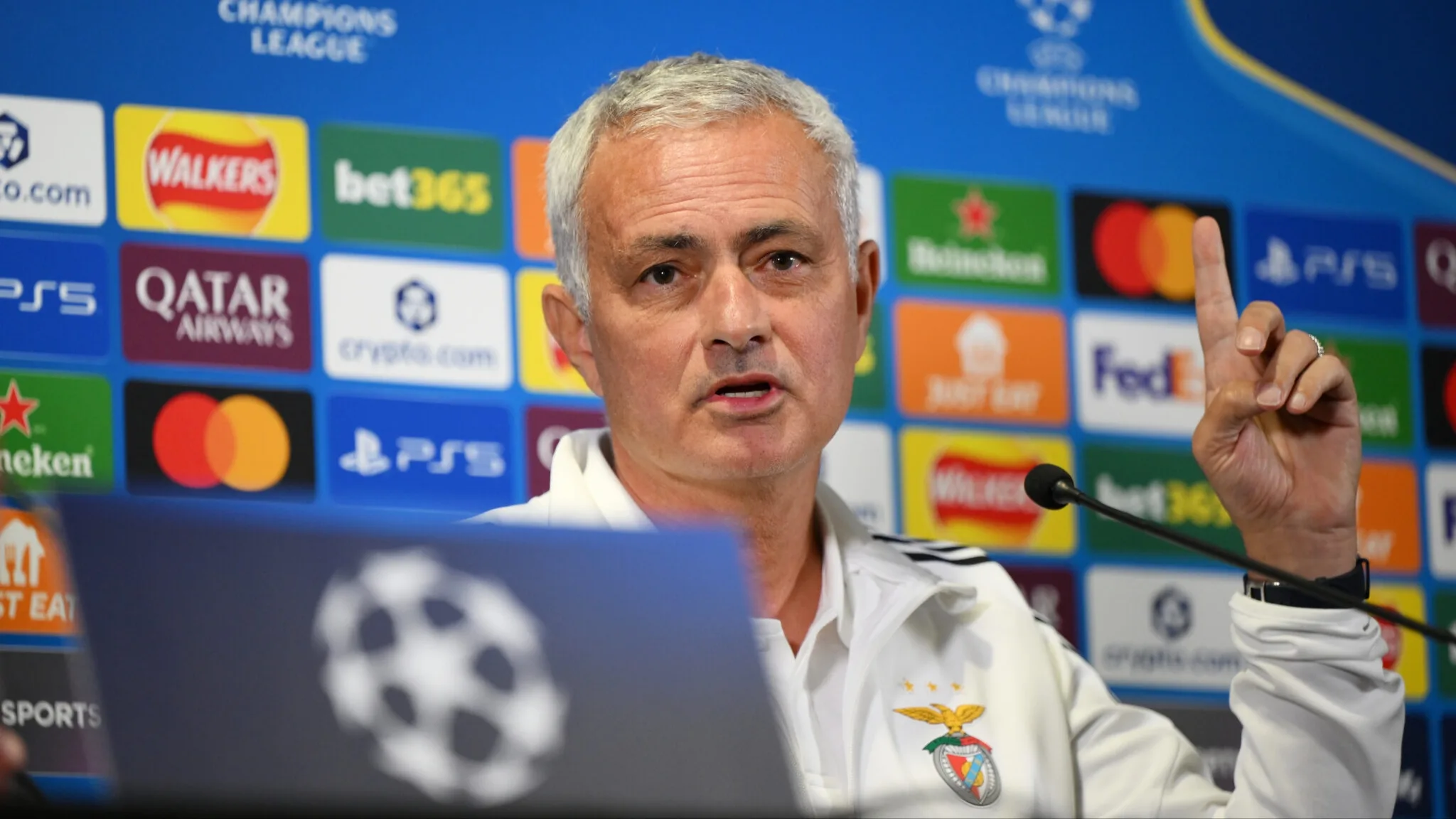
The lights of Stamford Bridge will shine again on José Mourinho, though this time he will not be walking out as Chelsea’s manager, but rather as the visiting coach of Benfica. On Tuesday evening, Mourinho returns to the pitch that witnessed much of his glory years, as his Benfica side takes on his old club in a Champions League group fixture that carries heavy narrative weight.
Mourinho, now 62, was officially appointed head coach of Benfica on September 18 on a contract running until the summer of 2027, with a break clause tied to the club’s upcoming presidential election. He replaces Bruno Lage, dismissed after Benfica’s shock 3-2 defeat to Qarabag in the opening round of this season’s Champions League.
The announcement of his return to Portuguese football was greeted with both excitement and surprise, given that he had been dismissed by Fenerbahçe only days earlier upon their elimination from the Champions League play-offs by Benfica.
For Chelsea, the reunion is laden with historical resonance. Mourinho’s two managerial spells at Stamford Bridge (2004–2007, 2013–2015) produced three Premier League titles and an era in which Chelsea rose to the top tier of European competition. His return, this time under a different banner, is sure to draw intense media scrutiny, fan sentiment, and emotional reflection.
In his pre-match press conference at the Ted Drake Suite, Mourinho embraced both his past and his present. “I will always be a Blue,” he said, before clarifying, “I am part of their history, and they are part of my history. … When I say I am not a Blue, I am only speaking about the job I have to do tomorrow.” He also adopted a bold tone, proclaiming himself “The Biggest One” in Chelsea’s managerial pantheon—at least until another coach wins more than the three Premier League titles he collected there. “So Chelsea is a winning machine. I’m ‘The Biggest One’ until someone wins four.”
Though Mourinho’s relationship with Chelsea has not always been sentimental—his return visits with clubs like Manchester United and Tottenham sometimes drew boos—this occasion is projected to be more celebratory. Chelsea ceremonially decorated their press conference room with framed photographs of Mourinho’s past triumphs at Stamford Bridge, a symbolic nod to his legacy.
Enzo Maresca, Chelsea’s current coach, said: “For me, personally, Mourinho is a legend for this club.” Portuguese international Pedro Neto, a winger in Chelsea’s ranks, added: “As a Portuguese I will be proud to play against (a team coached by) Mourinho … his contributions at Chelsea and elsewhere gave Portuguese people the chance to play for and manage the best clubs.”
But this will not simply be a nostalgic curtain call. Both clubs enter the game in a position of urgency. Chelsea began their Champions League campaign on the back foot, and domestic form has similarly shown signs of strain.
The squad enters with doubts over key players—Cole Palmer, Moisés Caicedo, João Pedro, and Andrey Santos are all in question. Benfica, meanwhile, also seek redemption after their disappointing start in Europe. The stakes in their group are already high, and this match will go a long way toward shaping the narrative of their campaign.
Mourinho’s arrival at Benfica carries a poetic symmetry: nearly 25 years ago, he had a brief stint as a youth coach with the Lisbon side. In taking the job now, he has spoken enthusiastically about the moral logic of his contract and the sense of responsibility he feels in returning to his homeland.
“It’s a contract with great ethics behind it,” he said when taking the role. “I want to work at Benfica … the promise is very clear. I will live for Benfica, for my mission.” Yet Mourinho is under no illusion about the challenges ahead. In a club election period, with high expectations in Portugal, and a Champions League tie at his old haunt, the spotlight is unrelenting.
In reflecting on Chelsea’s evolution, Mourinho acknowledged that the club had, for a period, lost part of its identity. “From the outside, it looked like Chelsea had lost the identity as a club,” he noted. “But what happened last season … it seems they are back on track. They gave trust to Enzo, he brought his ideas.” He also congratulated Chelsea for lifting the Club World Cup and pointed to those silverware moments as markers of belief. “It’s more difficult to win the Champions League than the Club World Cup,” he said, “but Chelsea has the potential to do it.”
This isn’t Mourinho’s first return to Stamford Bridge under opposing colors. He has walked out at the ground as the visiting coach of Inter, Manchester United, and Tottenham. Yet his legacy there endures, and the anticipation surrounding this match seems especially charged.
Some observers see the moment as further proof that Mourinho can still command big stages even late in his career. Others, however, caution that the modern game may have evolved past the peak methods of his earlier dominance.