
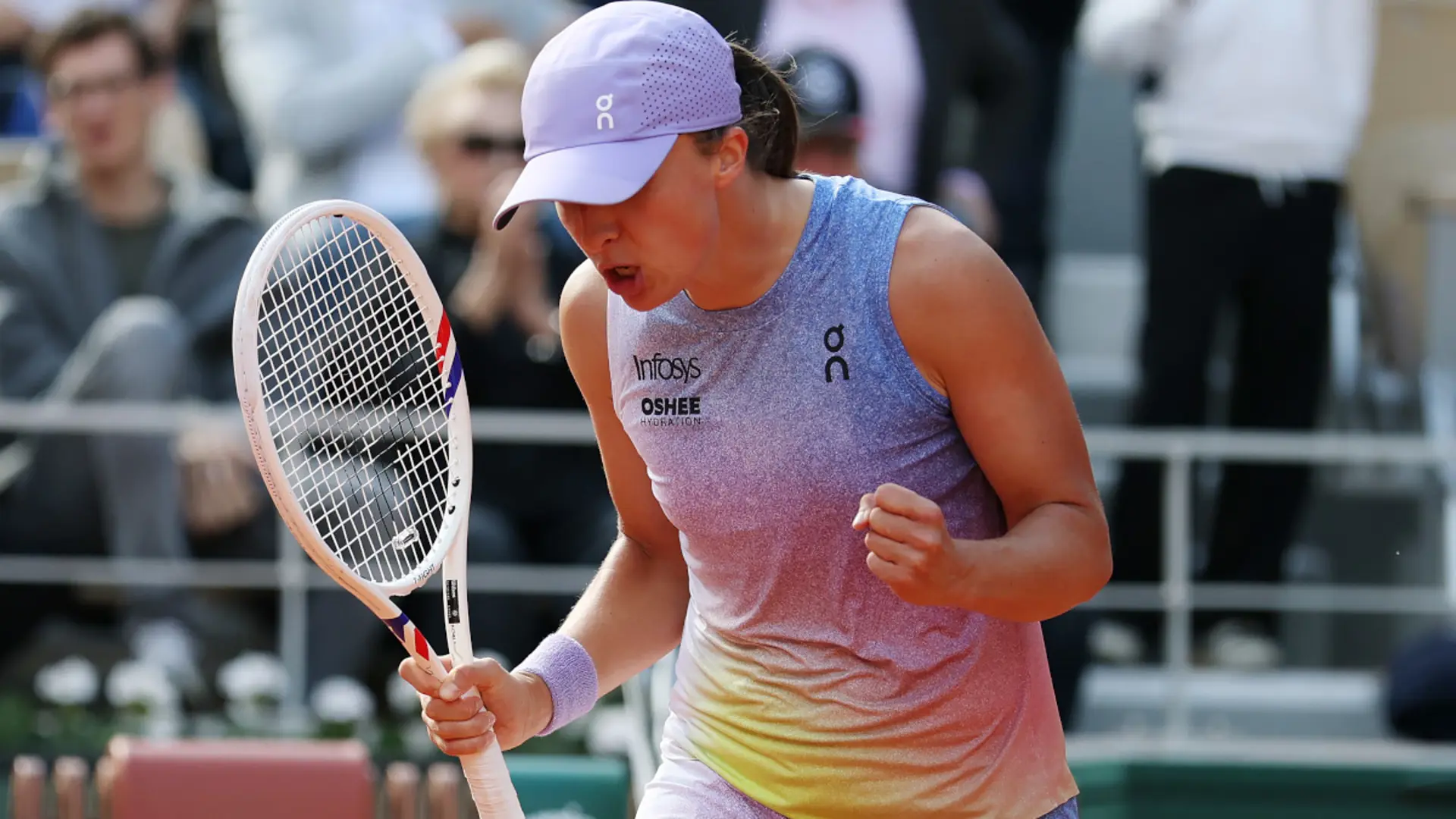
Defending French Open women’s champion Iga Swiatek has added her voice to the growing debate over scheduling disparities at Roland Garros, emphasizing the need for equal treatment of women’s matches in the tournament’s prestigious primetime evening sessions. Swiatek’s comments come amid ongoing criticism that women’s tennis is being sidelined in favor of men’s matches during the high-profile night slots, which begin after 8:15 p.m. local time and are exclusively broadcast by Amazon’s Prime service in France.
During her compelling third-round victory over Romania’s Jaqueline Cristian, with a score of 6-2, 7-5, Swiatek pointed to the lively atmosphere at Court Suzanne Lenglen as evidence of the entertainment value of women’s tennis. The crowd’s enthusiasm, marked by Mexican waves, underscored her argument that women’s matches are just as captivating as men’s. “Women’s matches can be entertainment the same way as men’s matches. As you could see today on my match, they were doing the Mexican waves and everything. So people like it,” Swiatek told reporters. “We can put on a nice show. That’s why I think it should be equal.”
The French Open has faced scrutiny for its scheduling practices since night sessions were introduced four years ago. This year, no women’s singles matches have been featured in the primetime slot during the first six days of the tournament, a stark contrast to the men’s matches that have dominated the evening schedule. The last women’s singles match to be played under the lights of Court Philippe Chatrier was the fourth-round clash between Aryna Sabalenka and Sloane Stephens on June 4, 2023. This imbalance has reignited discussions about fairness, with players like three-time Grand Slam runner-up Ons Jabeur vocalizing their frustrations. In a post on X, Jabeur stated, “Honouring one side of the sport shouldn’t mean ignoring the other,” highlighting the need for a more balanced approach.
The Women’s Tennis Association (WTA) has also weighed in, encouraging combined tournaments like the French Open to provide equitable scheduling that showcases both men’s and women’s tennis in premium slots. However, French Open tournament director Amelie Mauresmo, a two-time Grand Slam champion, defended the current scheduling, citing logistical challenges. Mauresmo noted that women’s matches, which are played over a maximum of three sets compared to the five sets in men’s matches, can conclude quickly, making it difficult to justify scheduling an additional match in the evening slot. “For me, the message is not changing, and it has never been that the girls are not worthy to play at night,” Mauresmo said. “It’s never been this. I’ll not accept that you carry this message.”
Swiatek, who has won four of the last five French Open titles and is chasing a historic fourth consecutive championship, acknowledged that she typically adapts to the schedule provided but maintained her stance on equality. Her comments echo a broader sentiment within the tennis community, with players like Venus Williams also reportedly speaking out against the night match imbalance. Posts on X have reflected this sentiment, with some users praising Swiatek’s advocacy while others noted the complexity of managing professional tennis scheduling.