
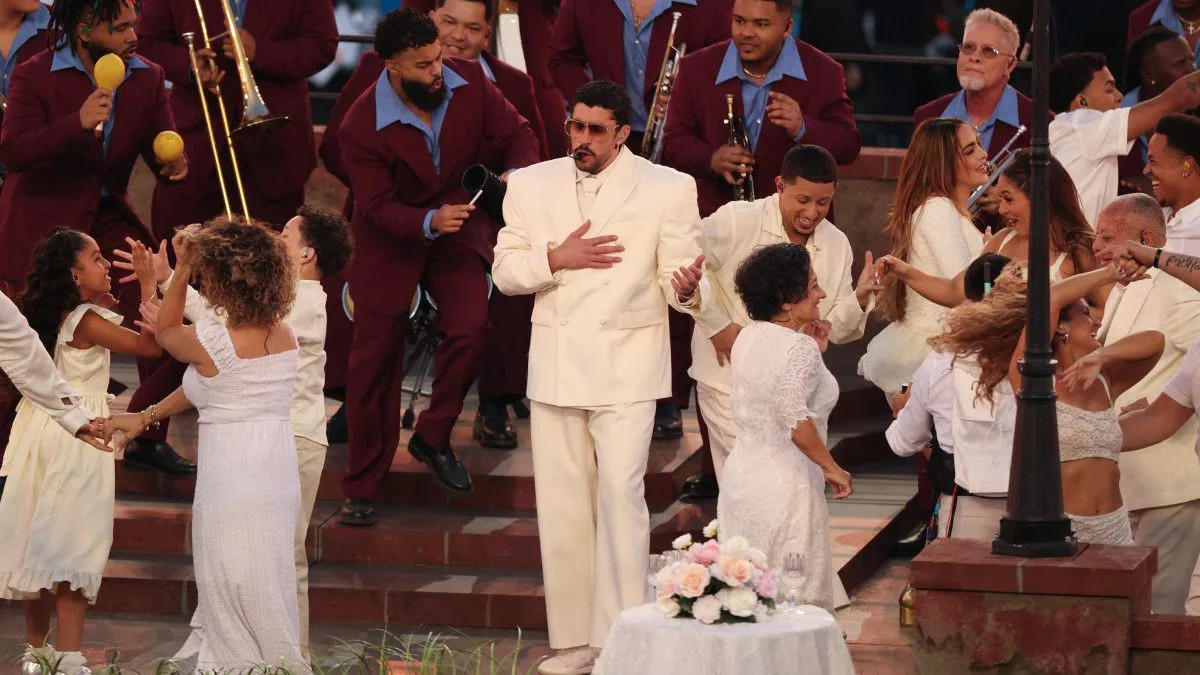
Former President Donald Trump ignited another culture war skirmish on Sunday, calling Bad Bunny’s Super Bowl LX halftime show “absolutely terrible, one of the worst, EVER” and “a slap in the face” to America.
The criticism, delivered via his Truth Social platform, targeted the performance’s Spanish-language delivery and its vibrant celebration of Puerto Rican culture, directly contrasting with the unifying message of continental solidarity that Bad Bunny delivered to a global audience.
Trump’s post, published shortly after the show concluded at Levi’s Stadium in Santa Clara, California, left no room for ambiguity. “It makes no sense, is an affront to the Greatness of America, and doesn’t represent our standards of Success, Creativity, or Excellence,” he wrote.

He specifically took issue with the performance being in Spanish, stating, “Nobody understands a word this guy is saying,” and called the dancing “disgusting, especially for young children”.
This condemnation was not unexpected, as Trump had previously labeled Bad Bunny a “terrible choice” for the coveted halftime slot.
The artist, born Benito Antonio Martínez Ocasio, crafted a 13-minute spectacle that was a defiant and detailed homage to his heritage.
The set transformed the football field into a slice of Puerto Rican life, complete with sugarcane fields, domino players, food vendors, and a replica of the “casita” central to his concerts.
His performance was conducted entirely in Spanish, a commitment he has maintained throughout his record-breaking career.

The show featured surprise appearances from Lady Gaga, who joined for a salsa rendition of “Die With a Smile,” and fellow Puerto Rican icon Ricky Martin.
The climax of the performance carried a potent political and cultural message.
As a cascade of flags from across the Americas filled the field, Bad Bunny expanded the traditional blessing. “God bless America,” he proclaimed, before naming over twenty nations from Chile to Canada, and concluding, “and my motherland, mi barrio, Puerto Rico, seguimos aquí” (“we’re still here”).
He then spiked a football inscribed with the phrase “Together, we are America,” as the stadium screen displayed: “The only thing more powerful than hate is love”. This closing statement served as a subtle but clear counterpoint to the criticism from Trump and other conservatives.
The conflict extends beyond a single performance. Bad Bunny, who made history just one week prior by winning the Grammy Award for Album of the Year for his Spanish-language record “Debí Tirar Más Fotos,” has been an outspoken critic of Trump’s immigration policies.
At the Grammys, he began an acceptance speech by stating, “Before I say thanks to God, I’m gonna say: ICE out!”. His decision to forgo a mainland U.S. tour for his latest album was influenced by concerns over Immigration and Customs Enforcement (ICE) raids at his concerts.
The political divide was further emphasized by conservative groups like Turning Point USA, which aired a counter-programming “All-American Halftime Show” featuring Kid Rock in response to Bad Bunny’s selection.
The reaction to the show from critics and fans was overwhelmingly positive, hailing it as a triumphant, career-defining moment that successfully brought a rich, specific cultural vision to the world’s biggest stage.
Trump’s sharp rebuke ensures that the debate over representation, language, and American identity will continue far beyond the football field, framing Bad Bunny’s performance as a landmark moment in the ongoing cultural discourse.