

In the rain-soaked atmosphere of Rabat’s Annex Olympic Stadium, Tunisia made a resounding statement of intent for their Africa Cup of Nations campaign, dispatching Uganda with a commanding 3-1 victory in their Group C opener.
On a Tuesday evening where the Moroccan weather tested the resolve of players and fans alike, the Carthage Eagles soared, ending a notable 12-year drought without a win in their opening match of the tournament. The match unfolded as a showcase of Tunisian efficiency and tactical discipline against a Ugandan side that, despite flashes of promise, struggled to translate possession into meaningful threats.
Goals from Ellyes Skhiri and a clinical brace from the outstanding Elias Achouri propelled Tunisia to the top of the group standings, setting a formidable benchmark for their rivals and sending a wave of optimism through their supporters.
From the opening whistle, Tunisia asserted a control that would define the entire contest. The midfield, orchestrated by the likes of Hannibal Mejbri, dictated the tempo, pressing Uganda high and forcing errors in dangerous areas. Their early dominance was rewarded in the 10th minute, breaking the deadlock from a set-piece, a known strength of this well-drilled side.
Hannibal Mejbri delivered a menacing corner into the box, where the experienced Ellyes Skhiri rose with authority. His powerful header crashed against the inside of the post and, in a moment of fortune for Tunisia, deflected off Ugandan defender Aziz Kayondo on the goal line and into the net.
The early goal was a perfect execution of a planned tactic, with Ugandan coach Paul Put later admitting his team had shown the North Africans “too much respect” and were not aggressive enough in such duels.
The goal did little to settle Uganda into a rhythm; instead, it emboldened the Carthage Eagles. They continued to probe, combining patience in buildup with sudden bursts of pace on the wings. Uganda, ranked 85th in the world to Tunisia’s 41st, found themselves largely contained, unable to muster a significant response despite seeing more of the ball.
The pressure told again five minutes before the interval. Building from the back, Tunisia carved Uganda open with a swift, incisive move. The ball found its way to Ali Abdi on the left, whose precise cross was met first-time by Elias Achouri. The forward’s technique was impeccable, steering a volley into the top-right corner of the net, leaving goalkeeper Salim Magoola with no chance.
The strike was a testament to Tunisia’s growing confidence and Achouri’s razor-sharp instincts, effectively putting the game beyond Uganda’s reach before the teams retreated for halftime.
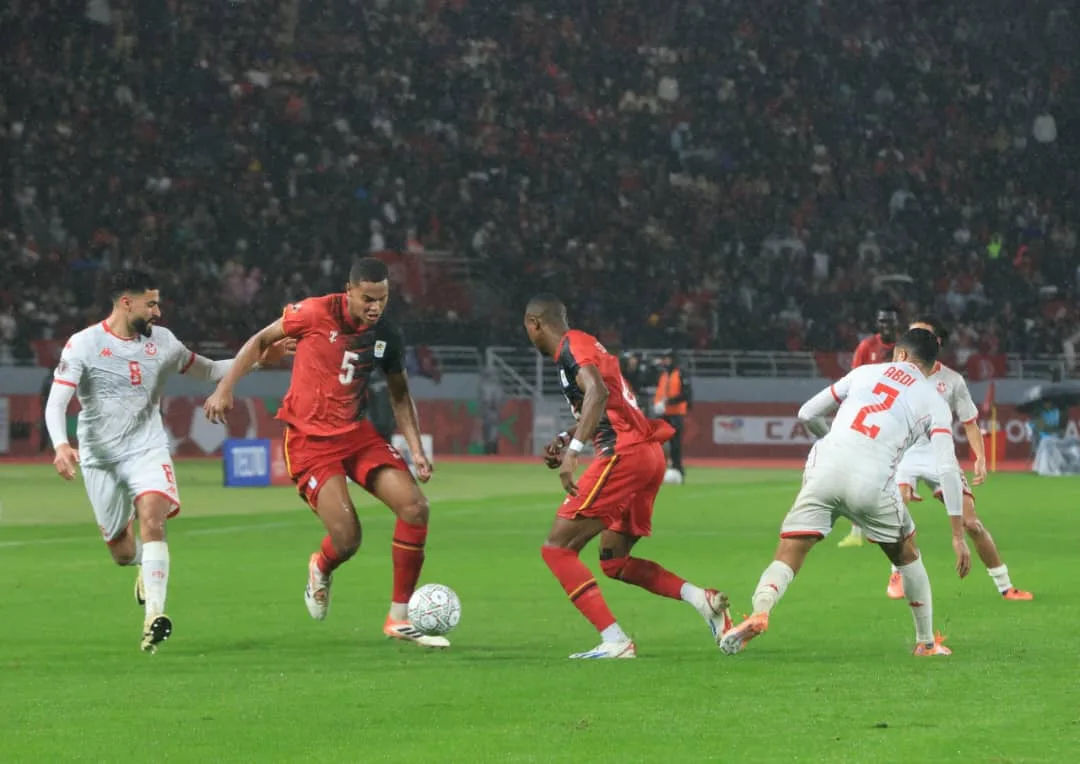
Facing a two-goal deficit, Ugandan coach Paul Put made decisive changes at the break, introducing attackers Travis Mutyaba and Denis Omedi in a bid to spark a revival. The alterations offered a brief flicker of renewed energy, but Tunisia’s defensive unit, marshaled by the experienced Yassine Meriah, remained compact and largely untroubled.
The Carthage Eagles, coached by the pragmatic Sami Trabelsi, wisely absorbed the fleeting period of pressure before delivering the decisive knockout blow. In the 64th minute, a sustained attack culminated in another Ali Abdi effort that Magoola could only parry weakly.
The rebound fell perfectly for the opportunistic Achouri, who had continued his run into the box, and he made no mistake, tapping into an empty net to secure his brace and Tunisia’s third goal. Achouri’s performance, earning him the Man of the Match accolade, underscored his vital role as the team’s attacking spearhead.
With the result firmly sealed, the match drifted toward its conclusion, the driving rain in Rabat mirroring Uganda’s dampened spirits. Tunisia managed the game with the maturity of a side fully in command, conserving energy and limiting risks.
The statistical story of the match, showing Uganda with 51% possession but only a single shot on target from nine attempts, perfectly encapsulated their frustrating evening of sterile dominance. Their sole moment of consolation arrived deep into second-half stoppage time.
Denis Omedi, one of the halftime substitutes, collected the ball on the edge of the area and unleashed a hopeful strike that took a heavy deflection off a Tunisian defender, wrong-footing goalkeeper Bechir Ben Said and nestling in the net. The goal was a mere footnote on the scoreline, doing nothing to alter the outcome but perhaps sparing Ugandan pride a little.
The final whistle confirmed a comprehensive 3-1 victory for Tunisia, a result that immediately reshapes the dynamics of Group C. For Sami Trabelsi’s men, the triumph was a perfect launchpad. In his post-match comments, the coach praised his team’s effectiveness and the warm welcome in Morocco, while already looking ahead with caution.
“For us, we consider all matches to be difficult, and we give them the respect required,” he stated, emphasizing that the goal is to “improve with each match as we gain momentum”. His star performer, Elias Achouri, dedicated the win to the teammates who provided him service and the loyal supporters who braved the cold and rain to back the team. The sentiment highlighted a collective spirit that will be crucial as the tournament progresses.