
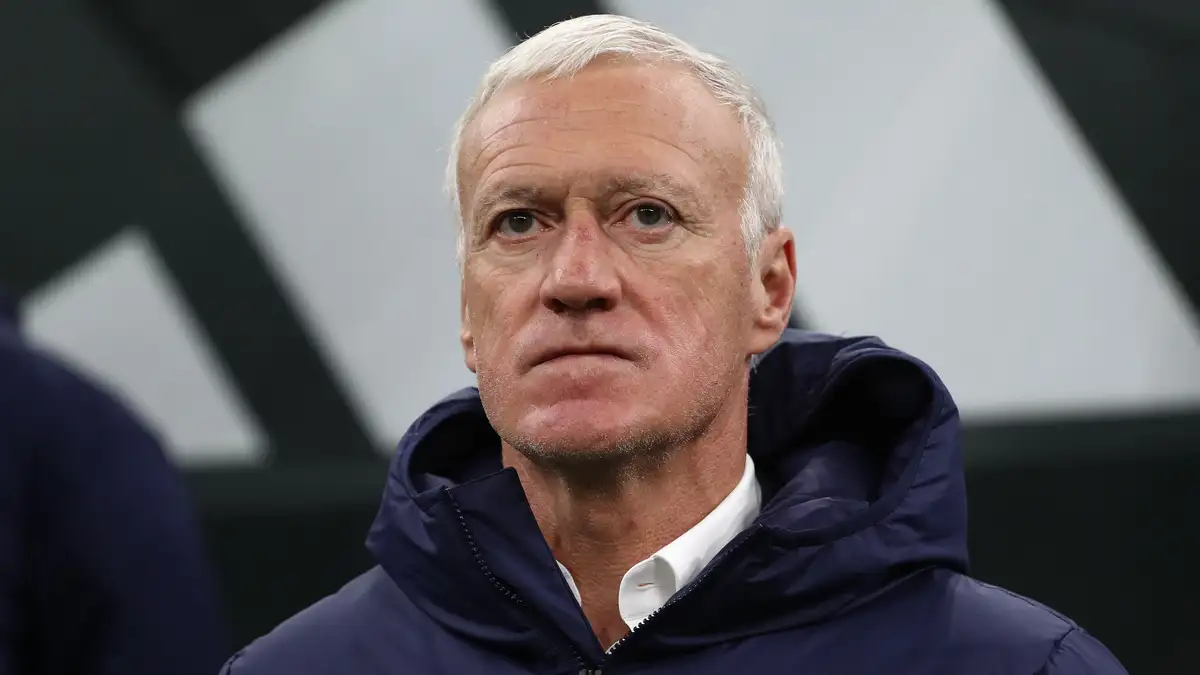
In the wake of mounting criticism from Paris Saint-Germain (PSG) over injuries sustained by Ousmane Dembele and Désiré Doué during France’s 2-0 World Cup qualifying victory over Ukraine, national team coach Didier Deschamps offered a staunch defense of his staff’s protocols and decisions.
Both players, who were part of PSG’s contingent, suffered significant muscle injuries—Dembele with a hamstring issue which will reportedly sideline him for around six weeks, and Doué with a calf strain expected to keep him out for approximately four weeks.
The club, alarmed by the timing and nature of the injuries, issued a strongly worded communiqué the day prior, alleging that the French Football Federation (FFF) had disregarded PSG’s medical warnings and protocols, deeming the injuries “serious and avoidable.”

At a press conference held on Monday ahead of France’s subsequent qualifier against Iceland, Deschamps acknowledged the setback but affirmed the medical and coaching staff had acted with professionalism and prudence. “It’s sad for Ousmane and for Desire of course, because of their injuries, and we’re losing two important players for tomorrow’s match,” he said. “But we did things in a professional and progressive way, as we always do with all the players, taking into account their own feelings.”
When pressed on the notion of friction between PSG and the national setup, Deschamps was emphatic that club and country should not be regarded as adversaries. “This concerns two PSG players. But PSG are not our opponent—clubs have never been. I’ve been on the other side of that fence myself. Our only opponent is Iceland, and that’s tomorrow,” he stressed.
More pointedly, Deschamps addressed the criticism about ignoring PSG’s medical briefs. PSG had claimed to have shared detailed information on acceptable workloads and injury risks prior to the players’ arrival at France camp, a request they say was disregarded.
In response, Deschamps assured that the decision to select and field the players was rooted in thorough assessment and dialogue with the players themselves, as well as with medical staff. “I was sure that he was capable of playing a high level match, otherwise I would not have played him… He was fit. It is unfortunate for him but could have happened to another player,” he said regarding Dembele’s inclusion.
Support for Deschamps didn’t end there. Aurélien Tchouaméni, the France midfielder and Kylian Mbappé’s teammate at Real Madrid, backed the coach, stressing that injuries are an inevitable part of football. “If a player feels it’s difficult for him to play because there’s a very high risk, the coach has always been understanding. He’s not stupid,” Tchouaméni remarked. “Sometimes problems (injuries) happen when you’re with the national team.”
PSG’s public response came quickly after the qualifying match on Friday, where both Dembele and Doué picked up their respective injuries.
The club demanded a “more transparent and collaborative medical protocol” between club and country, emphasising the need for documented communication and cautious player selection, especially for those already undergoing treatment for pre-existing conditions.