

Formula 1 and IndyCar represent the pinnacle of open-wheel, single-seater motorsport, captivating fans worldwide with their blend of speed, technology, and driver skill. At first glance, the two series may appear similar—both feature sleek, open-wheel cars racing at breakneck speeds—but they diverge significantly in their histories, regulations, car designs, race formats, and cultural identities. This article delves into the key differences between Formula 1 and IndyCar, exploring their unique characteristics and what sets them apart in the world of motorsport.
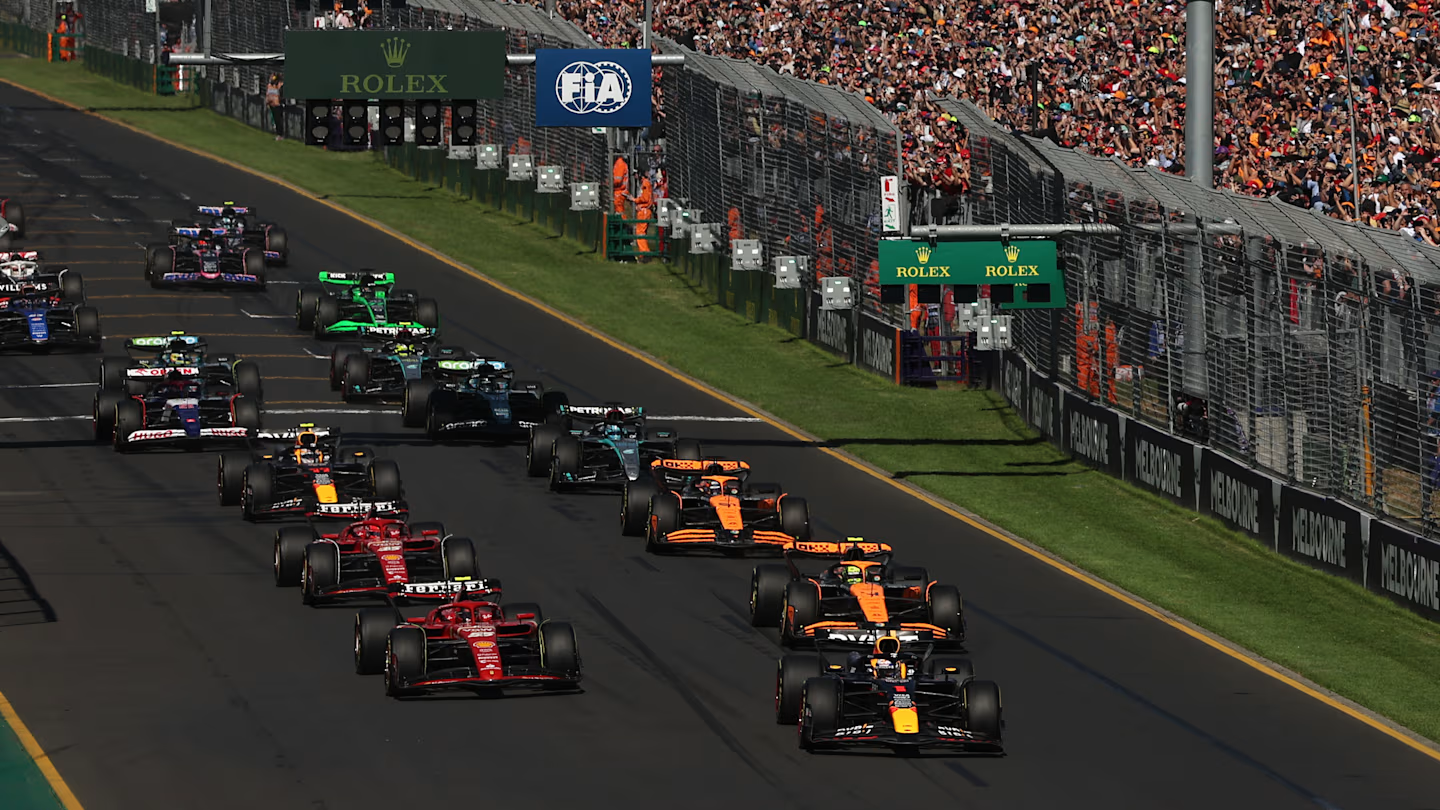
Historical roots and evolution
The origins of Formula 1 and IndyCar reflect their distinct identities. Formula 1, often regarded as the global pinnacle of motorsport, traces its roots to the Grand Prix racing of the 1920s and 1930s in Europe. The Fédération Internationale de l’Automobile (FIA) standardized rules in 1946, leading to the inaugural Formula 1 World Championship in 1950. Since then, F1 has grown into a glamorous, technology-driven series with a worldwide following, racing on iconic circuits like Monaco and Silverstone. Its history is marked by innovation, with teams like Ferrari and Mercedes pushing the boundaries of automotive engineering.
IndyCar, by contrast, is deeply rooted in North American racing culture. Its origins date back to 1905, with the American open-wheel championship that eventually evolved into the IndyCar Series. The modern IndyCar Series, as we know it, emerged in 1996 following a split from the CART series. The Indianapolis 500, first held in 1911, remains the crown jewel of IndyCar, often called “The Greatest Spectacle in Racing.” While Formula 1 has a global focus, IndyCar is primarily a North American series, with a heritage tied to oval racing and events like the Indy 500.
Interestingly, the two series briefly intersected from 1950 to 1960, when the Indianapolis 500 was part of the Formula 1 World Championship. This allowed American drivers to compete in F1’s record books, though most did not participate in other Grands Prix. Today, the two series operate independently, each catering to different audiences and racing philosophies.
Car design and technical specifications
One of the most striking differences between Formula 1 and IndyCar lies in their car designs and technical regulations. Formula 1 is a constructors’ championship, where teams like Mercedes, Red Bull, and Ferrari design and build their own chassis and develop highly sophisticated cars within the FIA’s regulations. This freedom fosters innovation, resulting in unique car designs with advanced aerodynamics, suspension systems, and power units. F1 cars use 1.6-liter V6 turbocharged hybrid engines, producing around 800 to 1,000 horsepower, depending on the hybrid system’s deployment. The Energy Recovery System (ERS) harvests energy during braking, providing an additional power boost. F1 cars are engineered for maximum downforce and cornering speed, allowing them to navigate complex road and street circuits with precision. However, their top speeds, typically around 205-220 mph, are slightly lower than IndyCar’s due to their focus on aerodynamic grip over straight-line speed.
IndyCar, on the other hand, is a spec series, meaning all teams use the same chassis, supplied by Dallara, and choose between two engine manufacturers: Honda or Chevrolet. These 2.2-liter V6 twin-turbo engines produce 550 to 750 horsepower, depending on the track, with an additional 60-120 horsepower available via the “Push to Pass” system, which provides a temporary boost. Since 2024, IndyCar has incorporated hybrid technology, using ultracapacitors to store energy regenerated during braking, delivering up to 150 horsepower per lap. Unlike F1’s bespoke designs, IndyCar’s standardized chassis and limited aerodynamic options level the playing field, emphasizing driver skill over engineering prowess. IndyCar tires, supplied by Firestone, are harder and more durable than F1’s Pirelli tires, prioritizing reliability for oval racing, where punctures can be catastrophic.
The physical differences between the cars are also notable. F1 cars are slightly heavier, with a minimum weight of 1,755 pounds, and feature 18-inch tires. IndyCar machines weigh between 1,635 and 1,785 pounds, depending on the track, and use 15-inch tires. F1 cars accelerate faster, reaching 200 mph in about 4.5 seconds, compared to IndyCar’s 8 seconds. However, IndyCars achieve higher top speeds, exceeding 240 mph on oval tracks like Indianapolis Motor Speedway, thanks to their low-downforce setups.
Race formats and track types
The types of tracks and race formats further distinguish Formula 1 from IndyCar. Formula 1 races exclusively on road courses and street circuits, with no oval tracks on its calendar. The 2025 F1 season features 24 races across 21 countries, including iconic venues like Monaco, Spa-Francorchamps, and newer additions like Miami and Las Vegas. F1 races are typically limited to a two-hour duration or a distance of around 189.5 miles, with pit stops focused solely on tire changes, as refueling has been banned since 2010. Teams must use at least two different tire compounds during a race, adding a strategic layer to tire management. The Drag Reduction System (DRS) aids overtaking by temporarily reducing drag on designated straights, allowing drivers to close gaps to competitors.
IndyCar’s calendar is more diverse, encompassing oval tracks, road courses, and street circuits. The 2025 IndyCar season includes 17 races, primarily in the United States, with one event in Canada. Oval racing, a hallmark of IndyCar, accounts for about a quarter of the schedule, including the Indianapolis 500, which covers 500 miles over 200 laps. Other notable tracks include road courses like Road America and street circuits like Long Beach. IndyCar races vary in length, with oval races running to a set distance and road/street courses often capped at two hours. Unlike F1, IndyCar permits refueling during pit stops, making fuel management a critical strategic element. The Push to Pass system, which provides a temporary horsepower boost, encourages overtaking, particularly on road and street courses.
The inclusion of oval tracks in IndyCar introduces a unique challenge absent in Formula 1. Oval racing demands sustained high speeds and precise car control, with drivers navigating banked turns at over 230 mph. This contrasts with F1’s focus on technical circuits that test cornering ability and braking precision. The diversity of IndyCar’s tracks requires drivers to adapt to vastly different conditions, while F1 drivers hone their skills on a more consistent set of circuit types.
Strategic and competitive dynamics
Strategy plays a pivotal role in both series, but the approaches differ due to their respective regulations. In Formula 1, tire management is paramount, as teams cannot refuel and must balance tire degradation with stint length. The choice of tire compounds—soft, medium, or hard—can make or break a race, with teams often adjusting strategies based on track conditions and competitor performance. The use of DRS adds a tactical element, allowing drivers to time their overtaking attempts carefully. F1’s constructor-driven nature means that car performance often overshadows driver skill, with top teams like Red Bull and Mercedes dominating due to their technological and financial advantages.
IndyCar’s spec-series format creates a more level playing field, where driver skill and strategy are paramount. Refueling during pit stops introduces fuel management as a key variable, with drivers conserving fuel to extend stints or capitalize on caution periods, such as full-course yellows, to pit without losing position. The Push to Pass system, limited to a set duration per race, requires drivers to decide when to deploy their boost for maximum effect. IndyCar races are often more unpredictable, with closer competition and more overtaking opportunities, as evidenced by 2023 data showing a lower percentage of races dominated by a single driver compared to F1, where Max Verstappen won 86.36% of races.
Safety and risk profiles
Both Formula 1 and IndyCar are inherently dangerous, but their safety challenges differ. F1 has made significant strides in safety since the 1990s, with innovations like the halo device, improved crash structures, and rigorous circuit standards reducing fatalities. The focus on road and street circuits means crashes often involve barriers or run-off areas, with lower risks of high-speed impacts into fences. However, F1’s high cornering speeds and complex tracks still pose significant risks, as seen in incidents like Romain Grosjean’s 2020 Bahrain crash.
IndyCar’s inclusion of oval tracks increases its risk profile. High-speed crashes on ovals, where cars travel at over 230 mph, can result in severe impacts with walls or catch fences, as highlighted by drivers like Max Verstappen, who cited IndyCar’s oval risks as a deterrent. IndyCar has implemented safety measures like the aeroscreen, a windshield-halo hybrid, and energy-absorbing barriers, but the nature of oval racing remains inherently perilous. The series’ history includes tragic incidents, underscoring the bravery required of its drivers.
Cultural and economic impact
Formula 1 and IndyCar occupy different cultural spaces within motorsport. F1 is a global phenomenon, with a billion fans and races in 21 countries, fueled by its glitz, glamour, and technological prestige. The Netflix series Drive to Survive has boosted its popularity, particularly in the United States, where new races in Miami and Las Vegas have expanded its footprint. F1 teams operate with budgets capped at $135 million per two-car team, but their global sponsorships and marketing make the sport a financial juggernaut. Driver salaries range from $1 million to over $45 million for stars like Max Verstappen and Lewis Hamilton.
IndyCar, while less glamorous, holds a special place in American racing culture. The Indianapolis 500 is a cultural institution, drawing over 5 million viewers in 2024. IndyCar’s North American focus limits its global reach, but its accessibility and competitive racing attract dedicated fans. Team budgets range from $7 million to $14 million per car, significantly lower than F1’s, and driver pay often relies on sponsorships, with top earners like Scott Dixon making $3.5-$4.5 million. IndyCar’s viewership, averaging 1.7 million per race in 2024, reflects its niche but passionate audience.
Driver crossover and skill sets
While some drivers, like Mario Andretti and Jacques Villeneuve, have excelled in both series, crossover is rare due to the distinct skill sets required. F1 drivers must master technical circuits and adapt to rapidly evolving car designs, with a premium on precision and consistency. IndyCar drivers face the unique challenge of oval racing, which demands courage, spatial awareness, and the ability to manage slipstreams and traffic. Drivers like Fernando Alonso, who attempted the Indy 500 with limited success, highlight the difficulty of transitioning between the two. IndyCar’s spec series rewards adaptability and raw talent, while F1’s constructor-driven format often requires drivers to maximize a car’s potential within its limitations.